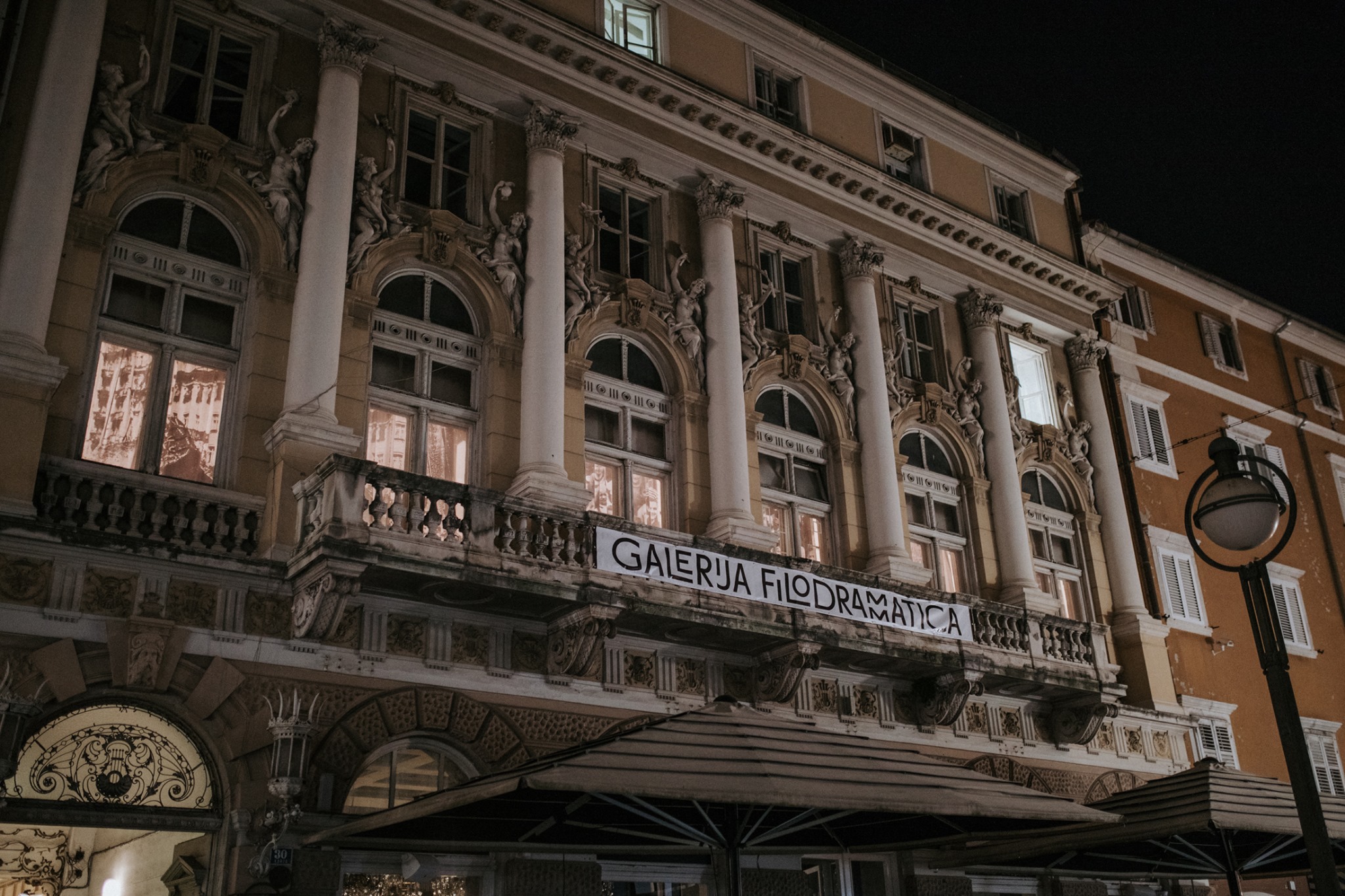


Find out more about our exhibition program for 2026!

Rosa Menkman: 'Image Remains' | 15 Jan – 5 Feb 2026
artist talk / exhibition opening: Thursday, 15 January at 7 pm / 8 pm
 Images courtesy of the artist
Rosa Menkman → (1983) is a Dutch artist, curator, and internationally renowned theorist specializing in glitch art → and the art and theory of resolution. As a pioneer of glitch art and one of the movement’s most influential theorists, in her book Network Notebook #04: The Glitch Moment(um) (2011) she proposed an understanding of glitch art as a particular genre of contemporary art. She has exhibited widely internationally, and her works are held in the collections of the Stedelijk Museum Amsterdam and the Art Institute of Chicago.
Drawing on Paul Klee’s famous painting Angelus Novus (1920) and Walter Benjamin’s philosophical interpretation of it as the “Angel of History,” her solo exhibition Image Remains explores what happens to images in the contemporary digital environment, as they are continuously copied, processed, fragmented, and circulated across various platforms and algorithms…
KEYWORDS: image, algorithms, digital circulation, fragmentation, technological obsolescence, regimes of power, myth
Sara Bezovšek & Dorijan Šiško: 'Black Box' | 19 Feb – 12 Mar 2026
exhibition opening: Thursday, 19 February at 7 pm
 Images: Marijo Županov / Aksioma (left), courtesy of the artists (right)
Sara Bezovšek → is a visual artist from Slovenia, working in the fields of internet art, experimental film and graphic design. Her artistic practice is characterized by reappropriation of online and pop cultural materials. Using a dense visual language of references, she taps into the collective imaginarium and constructs engaging narratives that are both a critique and a celebration of the highly saturated online media landscapes we navigate daily.
Dorijan Šiško → is an intermedia artist and graphic designer from Slovenia whose practice spans the fields of video games, experimental interfaces, spatial installations, 3D graphics, and digital art. In his practice he explores speculative, post-digital, post-internet, experimental, and critical aspects of art and design. By creating virtual visual-theoretical worlds, his works explore themes such as fringe digital culture, parallel realities, the dark side of the internet, alternative futures of humanity, and post-truth.
Their joint exhibition Black Box is an intermedia project in the form of a video game and spatial installation that shows how algorithms shape what we see on the internet and the identities we construct in the process. The player explores a deconstructed recommender system and navigates different aesthetic and ideological zones online, which today often appear confusing due to rapid political changes and clashes between various ideologies and beliefs. Since ideas and identities on the internet are most often expressed through aesthetics (styles, symbols, and memes), the game uses these visual languages to illustrate how identities are created, circulated, and transformed...
KEYWORDS: video game, installation, internet, memes, ideology, identity
Nika Rukavina: 'The Book of Invisible Influence' | 20 Mar – 10 Apr 2026
exhibition opening / artist talk: Thursday, 20 March at 7 pm / 8 pm
 Photos courtesy of the artist
Nika Rukavina → (b. 1980) is a contemporary artist from Rijeka known for her interdisciplinary approach, encompassing performance, installation, video, and sculpture. Her work explores themes of systemic discrimination, gender roles, and the psychological effects of social norms. Through acts of physical endurance and elements of audience participation, she creates a powerful critique of societal expectations, particularly those imposed on women. She has exhibited internationally in Belgium, Germany, Austria, Slovenia, and Italy, and in Croatia her work has been shown at the Museum of Contemporary Art Zagreb (MSU) and the Museum of Modern and Contemporary Art Rijeka (MMSU).
Through the exhibition The Book of Invisible Influence, the artist explores the invisible yet deeply ingrained patterns that shape women’s experiences from an early age. The starting point of the exhibition are the sentences women hear throughout their lives – from the “well-meaning” to the overtly violent – such as: “That’s not appropriate for a girl,” “Be quiet and endure,” “You’re too tomboyish,” “When you grow up, you’ll be a beautiful girl.” These everyday messages shape the way women perceive themselves, their bodies, and their own worth, often leading them to unconsciously accept the inequalities and limitations imposed by society…
KEYWORDS: installation, performance, women’s experience, book, video, audience participation
MINE, YOURS, OURS: 'The World is Sleepwalking', group exhibition | 23 Apr – 14 May 2026
curated by: Daniela Cotimbo / exhibition opening: Thursday, 23 April at 7 pm
+ conference: 24 & 25 April
 Images courtesy of the curator
In its 21st edition, Mine, Yours, Ours Festival focuses on a reality that can, in certain aspects, be described as a form of ‘waking dream.’ The current state of our world reflects many characteristics of dreaming: a continuous flow of improbable images and associations, whether in the form of deepfakes, memes, documentaries, or fragments of post-internet visual culture. The images we encounter daily reach the deepest layers of the unconscious, connecting intimate and personal dimensions with clichés, fears, deceptions, and collective rituals. A key feature of these images is that they reach our awareness even before any value has been assigned to them. This may help explain the phenomenon of brainrot, a recently coined term describing obsessive engagement with content that is soon forgotten.
Most of this visual output is generated by large artificial intelligence models. It has become clear that this technology can be fully transformed into a weapon of mass confusion—an instrument that, even when not directly employed in drones or other military technologies, is capable of intensifying ideological division.
The result of this collective psychosis is an entry into a post-truth regime: a universe in which the high probability of encountering misinformation alters our relationship to reality itself, moving us away from notions of objectivity and toward the search for comforting narratives and mythologies. Is it possible to transform these dreamlike currents into lucid dreams? And what is the real role of artificial intelligence in all of this?
This topic will be explored through works presented in the group exhibition The World Is Sleepwalking, curated by Italian curator Daniela Cotimbo, whose research focuses on issues surrounding the use of new technologies and the relationship between contemporary art and artificial intelligence. Among the participating artists is Zach Blas, a highly regarded contemporary artist, filmmaker, and writer whose practice investigates the philosophies and imaginaries embedded in computational technologies and the industries that shape them.
KEYWORDS: artificial intelligence, new technologies, video, installation, deepfake, brainrot
Ivan Marušić Klif: '64 Intercoms' | 28 May – 18 Jun 2026
artist talk / exhibition opening: Thursday, 28 May at 7 pm / 8 pm svibnja
 Images: Discogs (left), courtesy of the artist (right)
Ivan Marušić Klif → has, through three decades of activity on the Croatian art scene, established himself as one of the country’s most significant media and experimental artists. He graduated in 1994 from the School for Sound Design in Amsterdam. His practice includes kinetic, light, and video installations, as well as occasional performance, and he also works with music and sound within theatre, film, television, and music projects. He has exhibited across Europe and the United States (Mapping Festival, Geneva; Ars Electronica, Linz; Kibla, Maribor; Kapelica Gallery, Ljubljana; Kunsthalle Exnergasse WUK, Vienna, among others). His work focuses on the research and development of creative methodologies and tools, such as mobile camera systems, wobbulators, modified television sets, and custom software for controlling these devices.
Through the project 64 Intercoms, Klif develops a flexible system that can be used in various artistic contexts and become a lasting tool for future projects. The system consists of 64 identical units: stripped-down screens mounted on adjustable microphone stands, connected to central control and power supply. The screens are adapted to new mounts, the electronics are relocated into new housings, and all stands are connected to a video matrix that allows different content to be sent to each individual screen. This enables the creation of complex, synchronized visual sequences that respond to the spatial arrangement of the screens. Special attention is given to the development of software that allows for such manipulation. By using CRT screens (once ubiquitous and now obsolete technology), the project refers to Marshall McLuhan’s idea that outdated media acquire new value in art…
KEYWORDS: spatial installation, multimedia, video, obsolete technology
Hrvoje Spudić: 'Rotoprojector' | 10 Sep – 1 Oct 2026
artist talk / exhibition opening: Thursday, 10 September at 7 pm / 8 pm
 Images: Tanja Kanazir (left), courtesy the artist (right)
Hrvoje Spudić → (b. 1987, Zagreb) graduated in 2015 from the Faculty of Architecture, where he has worked since 2017—first as an assistant and later as an assistant professor—at the Drawing and Visual Arts Studio within the Department of Architectural Design. His practice operates across various forms of spatial art, through which he explores phenomena of light and sound, with a particular focus on the techniques and technologies of analog film, photography, and print. Since 2012, he has presented his artistic works, research, and collaborative projects through performances, projections, and numerous group and solo exhibitions in Croatia and internationally.
The exhibition Rotoprojector presents a long-term research project that questions the boundaries of film projection and its transformation into physical space. Drawing on mechanical principles and physiological phenomena such as afterimages and the persistence of vision, the project explores the possibility of transforming the flat surface of film projection into a three-dimensional, infinite space of light – inspired by the idea of the Cinéorama, a cinematic experiment by inventor Raoul Grimoin-Sanson from 1900. The work approaches film not as a window onto the world, but as a spatial and mechanical phenomenon: a luminous organism pulsating between image, machine, and gaze…
KEYWORDS:film, experiment, projection, installation, analog / digital technology
DISNOVATION.ORG: 'A Bestiary of the Anthropocene' | 15 Oct – 5 Nov 2026
artist talk / exhibition opening: Thursday, 15 October at 7 pm / 8 pm
 Images courtesy of the artists
Disnovation.org → is a research collective founded in Paris in 2012, consisting of Maria Roszkowska (Poland), Nicolas Maigret (France), and Baruch Gottlieb (Canada/Germany). The collective merges contemporary art, research and hacking to translate complex eco-social debates into operative and provocative exhibits. They create radical artworks staged as large laboratory experiments focused on energy, ecology and economics that work as catalysts for crafting futures that diverge from prevailing narratives. Their exhibits, books and videos permeated global cultural landscapes fostering a critical dialogue at the nexus of artistic, political and scientific inquiry. They have received numerous awards including Prize from the EU, S+T+ARTS in the city – ES/AT (2024), Opline Prize: Disruptive Art (Curators Prize), Paris (2021), the WRO Biennale Award (2019), and the Award for Artistic Technology Research, Vienna (2015). Their works have been exhibited, performed, and published worldwide and covered by media outlets such as Forbes, Wired, Vice, Motherboard, Libération, Die Zeit, Arte TV, Hyperallergic, Le Temps, among others. In Rijeka, their works were included in the group exhibitions World Without Us (Mali Salon, 2017) and The Sea is Glowing (Exportdrvo, 2020), organized by Drugo more.
Inspired by medieval bestiaries, A Bestiary of the Anthropocene presents a spatial installation exploring the hybrid creatures of our time. The project is conceived as a starting guide for observing, navigating, and orienting oneself within the increasingly artificial structure of the world. Examples include surveillance robot dogs, fordite, artificial grass, antenna trees, Sars-Covid-2, decapitated mountains, drone-fighting eagles, standardised bananas, etc. Each of these specimens are symptomatic of the rapidly transforming “post-natural” era we live in. Often without us even noticing them, these creatures exponentially spread and co-exist with us. Visitors are invited to reflect on the boundaries between technology, environment, and life, and to recognize how human actions shape a new “post-natural” reality…
KEYWORDS: spatial installation, Anthropocene, contemporary technology, artificial matter