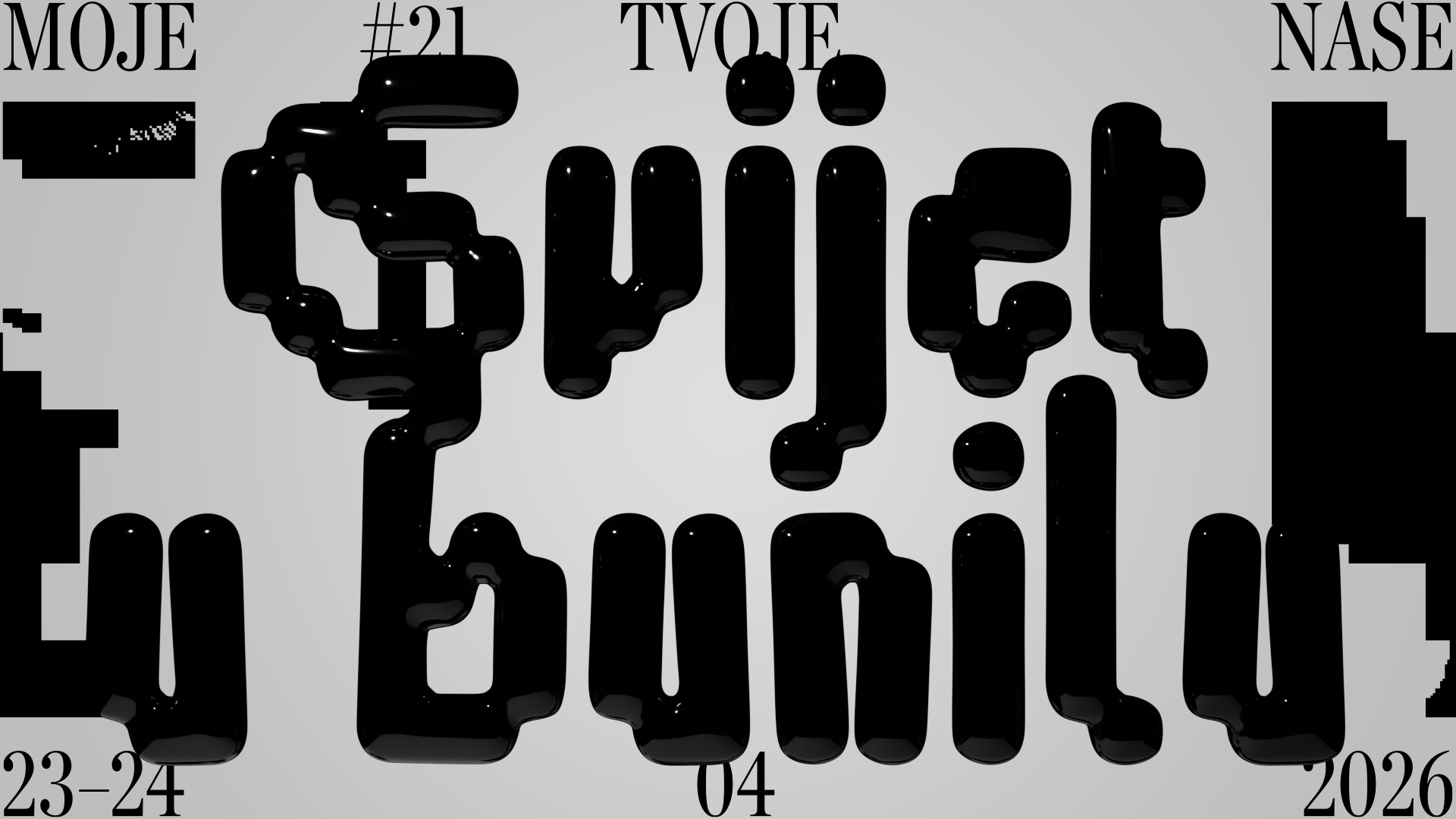
Exhibition
23 April – 14 May, 2026
Public talk
Friday, 24 April, 2026, at 6 pm
Filodrammatica (Korzo 28/1, Rijeka)
Gallery opening hours
Mon – Fri 11 a.m. – 1 p.m. + 5 – 8 p.m. | Sat 5 – 8 p.m. (contact us to arrange another time of your visit)

 Silvia Dal Dosso, The Future Is Now Finally Weird AF, video still, courtesy of the artist
Contemporary reality is increasingly described as a waking dream. Indeed, the current media landscape echoes many of the characteristics of dreaming: an incessant flow of unlikely content and improbable associations—deepfakes, memes, documentary fragments, and artifacts of post-internet culture. Images and words merge on the retina, reaching the most hidden corners of the unconscious and connecting intimate and personal dimensions with clichés, fears, delusions, and collective rituals.
A defining feature of these media flows is their ability to reach our consciousness even before any form of critical evaluation or value attribution takes place. This may help explain the phenomenon of brainrot and the compulsive fascination with absurd and nonsensical content. Another common characteristic of these cultural artifacts is that many of them are generated through large-scale artificial intelligence models. This is far from trivial: it is precisely the material conditions produced by the AI industry that encourage the proliferation of imaginaries and aesthetics in which high levels of realism and plausibility converge with AI’s inherent tendency to mine online archives in search of clichés and recurring semantic patterns.
Under the title The World Is Sleepwalking, this year’s 20th edition of the MINE, YOURS, OURS festival unfolds as a delirious journey to the edges of the synthetic world, suspended between wakefulness and sleep, in an attempt to inhabit this state of algorithmic trance.
Curated by Daniela Cotimbo
In collaboration with Re:humanism
☛ Filodrammatica Gallery, Korzo 28/1, Rijeka
WITH:
Zach Blas, Silvia Dal Dosso, Malpractice, Most Dismal Swamp
EXHIBITION OPENING:
Thursday, 23 April, at 8 p.m.
GALLERY OPENING HOURS:
Monday – Friday 11 a.m. – 1 p.m. | 5 – 8 p.m.
Saturday 5 – 8 p.m.
**************
☛ Filodrammatica, large hall, Korzo 28/1, Rijeka
.
6 p.m. – Daniela Cotimbo introduces The World Is Sleepwalking
6:15 p.m. – Zach Blas, lecture
6:45 p.m. – Silvia Dal Dosso, Malpractice, Most Dismal Swamp, artist talk moderated by Davor Mišković
7:45 p.m. – performance by Malpractice
**the program is in English
The rampant production of synthetic artifacts has not gone unnoticed politically. While the AI industry promises enormous economic advantages—often grounded in the commodification of narratives rather than products or services—it has become increasingly evident that this technology can also operate as a weapon of mass confusion: a tool capable of reinforcing ideological rhetoric, if not directly deployed in the operation of drones and other military technologies.
The result of this collective psychosis is our entry into a regime of uncertainty—an environment in which the high probability of encountering fabricated content has profoundly altered our relationship with reality itself, shifting it away from notions of objectivity toward the search for reassuring stories and mythologies. On the one hand, we strongly advocate for tools capable of verifying authenticity; on the other, we allow ourselves to drift within a fluctuating landscape of absurd narratives and conspiracy theories.
 Zach Blas, IUDICIUM, HD video stills, courtesy of the artist
If, as Claude Lévi-Strauss argued, the production of myth is a foundational mechanism of cultural thought, the typology and quality of contemporary mythologies now appear increasingly shaped by the extractive logic embedded within algorithmic culture. Who, then, holds agency over these narratives? Is it possible to transform these dreamlike flows into lucid dreams? And what role does AI actually play within this condition?
It is from these questions that The World Is Sleepwalking takes shape. A constellation of artists, practitioners, and various kinds of algorithmic sleepwalkers engage with these issues in order to outline new perspectives capable of opening the algorithmic black box, recovering dreams, nightmares, distortions, and hallucinations in an attempt to break the fourth wall.
The exhibition explores how these authors construct speculative scenarios that challenge the very nature of artificial intelligence itself.
We have entered the era of post-post-post-truth, as suggested in one of the video essays narrated by a synthetic version of Adam Curtis’s voice, part of the trilogy The Future Is Weird AF by Silvia Dal Dosso. Here, a universe populated by resurrected celebrities, billionaires retreating into underground bunkers, virtual influencers, emotional advertising, and human–bot relationships forms the dystopian landscape of contemporary media reality.
This sense of cultural vertigo materializes in The Bastard Field by Most Dismal Swamp, a world inhabited by figures at the limits of imagination, immersed in a feverish dimension suspended between collective hallucination and sublime yet hostile architectures. Within this vision, the swamp emerges as a powerful metaphor of collapse: a liminal space where psychic crisis and the excesses of AI models become entangled.
 Most Dismal Swamp, The Bastard Field, courtesy of the artists
If all this may appear as pure generative delirium, Zack Blas’s installation Iudicium, with its apocalyptic and eschatological undertones, exposes the messianic impulses of Silicon Valley tech culture, connecting ancient and contemporary rituals, esotericism, surveillance, and fantasies of omnipotence in which the new god of AI reduces life to abstraction and prediction.
It may therefore be time to turn to AI Fatigue Rehab Agent, the conversational bot developed by the duo Malpractice as both a therapeutic device and a pressure valve for the burnout produced by the uncritical adoption of generative AI. In a world driven by optimization, how might we enact a true technological détournement?
Read more about the works below ↓
The exhibition will be accompanied by a public program featuring the artists and the curator, scheduled for April 24.
CURATOR: DANIELA COTIMBO

PRESENTED WORKS / ARTISTS:
Silvia Dal Dosso
The Future Is Weird AF (2023-2025)
– video installation

We live in a time of great ambiguity and confusion. Events keep happening that seem unreal and out of control. Dead celebrities are coming back from heaven in every shape and size. Creators are desperately trying to capitalise on pop culture’s ancient splendour. Hyper-flexible humanoid robots are getting ready to cook our eggs. LLMs are unleashed on social media to generate synthetic data and consensus. Internet memers are living a new cursed golden era. Tech overlords are going all in on AGI, using war as their open-air R&D studio. Millionaires are hiding at the bottom of the earth. While the rest of humankind is trapped in a mediated reality, where love is constantly intercepted by emotional advertising, robots and ASMR illusions of pleasure. All around them, the world is burning.
The Future Is Weird AF Trilogy is a time capsule installation telling the story of the 3 years (2023–2025) in which LLMs, generative artificial intelligence, and other related AI industry products entered our lives, reaching massive-scale usage. And of how while generated AI imagery, such as the notorious Will Smith’s Spaghetti, was getting more and more “fine”, the world we were raised to survive in was becoming weirder, faster and harder.
The video works are inspired by the internet Corecore movement and by the documentaries of BBC filmmaker Adam Curtis. As with Curtis’s films, this project is built from found footage. The archival material was not courtesy of BBC, but illegally gathered from the endless stream of news, fragments, and oddities that haunt us online.
The synthetic voice of Curtis is recreated by the artist with the ElevenLabs AI text-to-speech software, alongside a rich variety of sound effects. This text-to-voice intervention is the only AI software used in the work. The rest is pure human obsession, as the artist is trying to make sense of the abundant deluge of images, videos and sound through video editing and writing.
Silvia Dal Dosso is an artist, writer and a researcher in digital technologies and web subcultures. In 2016 she co-founded Clusterduck, an art collective working in the fields of research, design and transmedia. Her practice spans new media, interactive installations, and transmedia storytelling, often translating complex digital phenomena into tangible, participative experiences. Her works have been exhibited in venues such as KW Institute for Contemporary Art, Berlin; Kunsthal Charlottenborg, Copenhagen; Galerie Rudolfinum, Prague; Ars Electronica, Linz; ICA, London; Villa Arson, Nice; Transmediale, Berlin; Gallerie d’Italia, Naples; Het Nieuwe Instituut, Rotterdam; Aksioma, Ljubljana; The Influencers, Barcelona; Werkleitz Festival, Halle (Saale); Impakt Festival, Utrecht; re:publica, Berlin; AFO Festival, Olomouc; Cineglobe du CERN, Geneva; IFFR, Rotterdam (among others).

Most Dismal Swamp
The Bastard Fields (2025)
– looping video, forced hallucinations, forced collaborations

The Bastard Fields is a degenerative fever-dream emerging from a slumgullion world of model-collapsed realities. It dredges our emerging neural mediascapes and their adversarial hallucinations as a sublimely toxic ‘hostile architecture’.
The cast of The Bastard Fields includes an embittered bog body discussing exit strategies with a homemade robot, two creative directors cooking up some dank reality-settings among a DIY Splinternet, a mystic rabbit vlogging on the nature of rabbit holes and burrows, an outlaw preacher tending his field conventicle, and poor little Brownie is martyred 🙁
This is the clamour and humiliation of content at the end of the world.
Most Dismal Swamp is a mixed-reality biome; a place and a practice where a dank miasma of fictions, artists, model worlds, adversarial realisms, external hard drives, camera-tracking data, campfires, opaque rituals, game engines, amateur heresies, visual effects plug-ins, and other animals come together. Emerging from the curation, artwork, and research of Dane Sutherland, Most Dismal Swamp’s multimedia projects involve collaboration, commissioning, and convivial speculation with many other artists. These projects are modular and densely populated, presented across various immersive and bespoke installations and online; Multi-User Shared Hallucinations dredged from the slumgullion swamp of adversarial digital, platform, and neural media. A rigorous ‘acid pessimism’ inspirits the work of Most Dismal Swamp: an acerbic yet playful immersion into the composite hallucinatory lifeworlds, gamespaces, and protocols that make up the hostile architecture of our shared platform-mediated crises.

Zach Blas
IUDICIUM (2022)
– installation

Addressing a burgeoning AI religiosity in the tech industry, IUDICIUM is a multimedia installation that frames AI-driven evaluation as modes of religious judgment. From assessing financial risk and medical ailments to calculating consumer choice and targets of war, AI systems analyze data in order to automate decisions, carrying benign and revelatory consequences. Far from purely technical, much of automated decision-making exists within a broader context of Silicon Valley ideologies that direct AI toward neoliberal, techno-utopian ends. A component of this ideology is a religious eschatology, manifesting through the belief that AI can generate and deliver just destinies to humanity, whether transformation and liberation or punishment and death. IUDICIUM exposes this computational world of divine judgment, where artificial intelligence exists alongside corporate gods, mystical glyphs, religious icons, occult sigils, and captured bodies.
Presented as a computational re-imagining of Michelangelo’s Last Judgment fresco that covers the Sistine Chapel’s altar wall, IUDICIUM consists of a towering computer graphics painting projected in a darkened space of worship, accompanied by a soundtrack composed from machine learning-generated text and audio. IUDICIUM takes its name from the AI god of judgement the installation conjures, a flesh-eating arbiter who keeps humanity incessantly subjected to modes of judgment, promising immortality and transcendence to an elite class and domination for the rest.
At the center of the painting, an ornate black cube rotates, displaying glowing red sigils and occult diagrams on each of its sides. Evoking the puzzle box of Clive Barker’s horror film Hellraiser, black box computational systems, and the bounding boxes of AI image processing, this die–a predictive technology–determines the fate of those awaiting the god’s judgment. The esoteric symbology on the cube’s faces combines biometric abstraction, sacred geometry, neural network diagrams, etchings of torture devices, and religious icons. One side features the outline of a captured body taken from the interface of an airport security body scanner, while another shows the monas hieroglyphica, an emblem of Elizabethan mystic-mathematician-imperialist John Dee. Additional symbols and sigils appear from previous works Contra-Internet (2015-19), Sanctum (2018), Icosahedron (2019), and The Doors (2019). Surrounding the black cube, fragmented chunks of face cages, based on biometric facial mapping, float and spin, while the god’s hands, rendered as Spanish Ticklers, roll the die.
A digitally modulated voice performs a sermon in a distorted growl. Its sinister proclamations were built from machine learning-generated text output from models trained on tech corporation mission statements, eschatological religious texts, philosophical writing on morality and justice, apocalyptic science fiction, and sermons about divine judgement. Machine learning was also used to produce the music and atmospheric audio, trance-like droning that accompanies the speech.
Everybody shall be judged. Exposing our desire for its algorithmic arbitration and demanding our obedience, the god reduces flesh to abstraction, remaking human anatomies into the data it consumes.
IUDICIUM is a companion piece to Blas’s Silicon Traces series, a trilogy of moving image installations and related works that contends with the histories, philosophies, beliefs, fictions, and fantasies that shape Silicon Valley’s visions of the future as means to domination. The AI god of judgment first introduced in IUDICIUM is featured in CULTUS, the second installment of the trilogy.
Commissioned for the 2022 MUNCH Triennale and supported by the Tallinn Art Hall Foundation.
Zach Blas is an artist, writer, and filmmaker whose practice contends with computational technologies, their industries, and the powers that constitute and animate them. Blas has exhibited in major international exhibitions including the 82nd Whitney Biennial, New York (2026); 12th Berlin Biennale for Contemporary Art (2022); and 12th Gwangju Biennale (2018). He has also presented solo exhibitions at Vienna Secession (2024); Van Abbemuseum, Eindhoven (2020); Abierto x Obras, Matadero Madrid (2018); and Gasworks, London (2017). His publications include the artist book Ass of God: Collected Heretical Writings of Salb Hacz (Vienna Secession and Verlag der Buchhandlung Walther und Franz König, 2024) and the artist monograph Unknown Ideals (Sternberg Press and Haus für Medienkunst Oldenburg, 2021). With Melody Jue and Jennifer Rhee, he is co-editor of Informatics of Domination (Duke University, 2025). Blas is an Assistant Professor of Visual Studies in the Daniels Faculty at the University of Toronto.

Malpractice (Chiara Kristler & Marcin Ratajczyk)
AI Fatigue Rehab Agent (2026)
– installation

In January 2025, Malpractice installed the AI Fatigue Rehab Agent, an AI voice agent, at Rhiz, a nightclub in Vienna. Visitors called it on the phone to talk about being tired of AI. It ran on a commercial customer service platform repurposed as para-therapeutic infrastructure, asking open-ended questions about people’s relationships with AI exhaustion. People tried to break it, provoke it, steer it off-topic but the agent kept pulling them back. What was built as synthetic exposure therapy functioned, in practice, as gaslighting.
A year later, the question is no longer whether people are tired of AI but what that tiredness is made of. Economic displacement, environmental cost, the sloppification of public life, cognitive debt from sorting real from synthetic, AI-induced psychosis, the fatigue of prompting itself. The agent has been rebuilt to address this, assuming exhaustion and probing how people deal with it.
In the weeks before the exhibition, the updated agent went live. The Rijeka conversations are the new archive. Two screens, stacked vertically, form a single interface. One plays the conversations over fast flickering AI-generated images produced from the content of each exchange. The other maps the conversation data diagrammatically.
The installation captures a moment in the adolescence of synthetic cognition, a period defined less by what AI produces than by what repeated exposure to it does to perception.
Malpractice is a Polish–Austrian–Italian artist collective composed of Chiara Kristler, Marcin Ratajczyk, and a shifting ensemble of AI counterparts. The group explores the aesthetics and affordances of beyond-human agency through projects that embed artificial intelligence into academic, artistic, and social infrastructures. Rather than using AI as a tool, Malpractice treats it as a collaborator in distributed creative processes where authorship becomes porous and plural. They build systems that observe, interact, and occasionally malfunction in public, testing the limits of synthetic subjectivity, interface performance, and shared autonomy. Malpractice tries to live up to their name. Selected Exhibitions:“Post-Turbulence” (Y3 Pavilion, Tanhualin Historic & Cultural District, Wuhan, 2026), “The Second Guess: Body Anxiety in the Age of AI” (House of Electronic Arts Basel, online), “Virtually Yours” (SCHLACHTER 151, Berlin), “We Emotional Cyborgs” (Digital Art Mile during Art Basel 2025, Basel), the performative lecture “Agents as a Medium: Prompting Against the Default” (Vienna Digital Cultures Festival, Vienna), and the artist talk “Prompted Perspectives” (HFBK Hamburg).


