Photo: Ana Križanec / Drugo more (Flickr gallery)
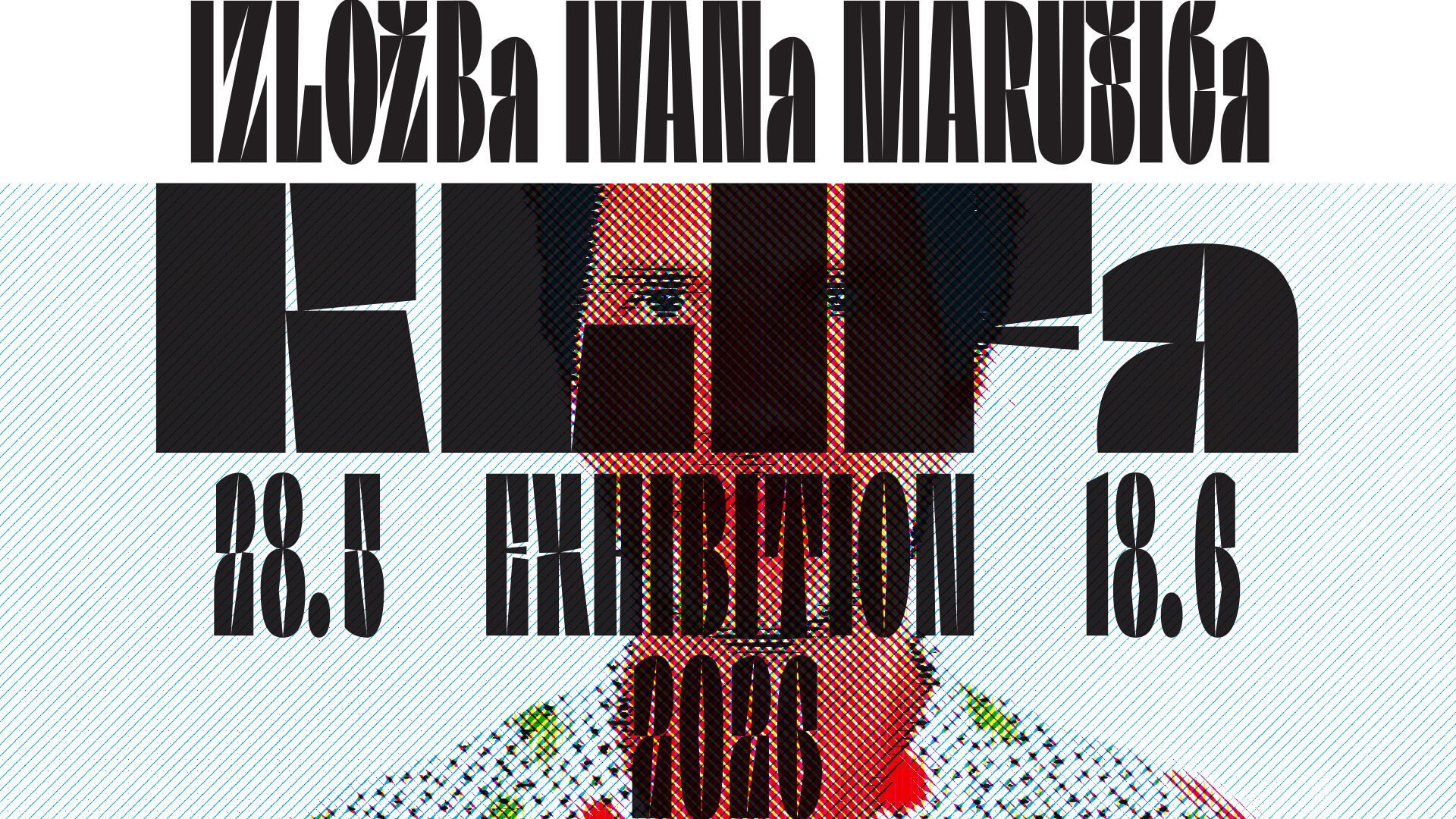
We continue our gallery programme with Ivan Marušić Klif, one of Croatia’s leading media and experimental artists. From 28 May to 18 June, Filodrammatica Gallery will host his new installation, co-produced by the Zagreb-based organisation KONTEJNER | bureau of contemporary art praxis.
Using CRT monitors — a once-ubiquitous technology now largely obsolete — Klif’s new project engages with media theorist Marshall McLuhan’s idea that older technologies can acquire new meaning and value within artistic practice.
The exhibition opens on Thursday, 28 May at 8 pm. One hour earlier, at 7 pm, artist Ivan Marušić Klif will be in conversation with Tereza Teklić of KONTEJNER.
Installation @ Filodrammatica Gallery, video: Borut Brozović
»Every new work begins for me as an encounter with uncertainty and a strong inner energy. The moment an idea moves from sketch to material form and begins to occupy real space marks the beginning of a process in which a system, often developed over many months, starts functioning according to patterns that only gradually become visible — and which frequently differ from what I initially imagined.
Experience has taught me that a new system can never be fully understood at the beginning. During production, my attention is primarily focused on practical questions and technical challenges, while the work’s meaning slowly crystallises through the process itself. For this reason, I chose not to conceal this somewhat uncomfortable aspect of my creative practice, but instead to deliberately incorporate it into the installation and open it up through the accompanying conversation. I am drawn to uncertainty, error, adaptation, and learning as inseparable elements of artistic practice.

This multi-channel video installation consists of 48 black-and-white screens salvaged from video intercom systems. Although cathode-ray tubes¹ have long occupied an important place in my artistic practice, this is the first time I have worked with this particular type of monitor: small, flat screens whose image is imperfect, distorted, and occasionally unstable. It is precisely within these irregularities that I recognise their particular value.

Removed from their original casings and mounted within a newly constructed framework, the screens are exposed from all sides, including the reverse, where the video image remains visible. In this way, the monitor ceases to function merely as a display surface and instead becomes a spatial object that occupies and actively shapes its environment.
Each screen assembly is connected through a shared video matrix system, enabling every device to receive an individual visual signal — live camera feeds, material generated through video synthesizers, or pre-prepared multichannel sequences played from a computer.
This structure operates not only as a technical system of image distribution, but as a dynamic field of relationships between individual screens and the space they collectively construct. The system allows synchronised transformations across all monitors simultaneously, producing complex choreographies of moving images: content travels from screen to screen, shifts through rows and columns, circulates, contracts, and expands. Visual flow thus becomes a spatial composition in which the image is not experienced in isolation, but as a process that moves, fragments, and reconstitutes itself across a network of devices.
In this sense, the work functions as a kind of multi-channel video instrument. Rather than presenting a fixed, linear projection, the system enables the live performance of image — composing rhythm, repetition, interruption, and relationships between screens and space in real time. Each monitor becomes an individual voice within a larger visual structure, while the installation behaves like an instrument that can be played, improvised with, and endlessly reconfigured.«
– Ivan Marušić Klif, artist statement for the Rijeka exhibition
¹ cathode-ray tube (CRT): a complex electronic vacuum tube that uses an electron beam to illuminate a fluorescent screen, producing an image.

Technical support: Branimir Štivić, Ivan Čadež
Co-production: KONTEJNER | biro suvremene umjetničke prakse
The project is supported by: City of Zagreb, Ministry of Culture and Media of the Republic of Croatia
ABOUT THE AUTHOR
Ivan Marušić Klif is one of the prominent figures of Croatia’s experimental media art scene. He graduated in 1994 from the School of Audio Engineering in Amsterdam. His practice encompasses kinetic, light, and video installations, as well as occasional performance work. He also works with music and sound for theatre, film, television, and musical productions. He has exhibited and performed throughout Europe, Asia, and the United States. His awards include the Vladimir Nazor Award for Best Exhibition (2012), the Audience Award at T-HTnagrada@msu.hr (2007, 2012), and First Prize at the 26th Youth Salon (2001).
About the moderator
Tereza Teklić holds degrees in Art History and German Language and Literature from the Faculty of Humanities and Social Sciences in Zagreb. She is a member of KONTEJNER | bureau of contemporary art praxis, an organisation dedicated to progressive contemporary intermedia art, sound art, and experimental music, with a particular focus on projects exploring the role of science, technology, and the body in contemporary society. Since 2008, she has worked continuously as a project coordinator, manager, and curator within KONTEJNER, where she currently serves as director. Over the years, she has contributed to numerous curatorial projects in Croatia and internationally, including the Device_art Festival (2012–2021), the interactive installations programme within Rijeka 2020 – European Capital of Culture, the Gallery Močvara and KONTEJNER exhibition programme, and the project Mjestimice svjetlo, among others. She also curates and produces works by Croatian and international artists and leads EU-funded international collaborations. In 2022, she was one of the organisers of the Croatian Pavilion at the 59th International Art Exhibition of the Venice Biennale and producer of the work by Tomo Savić-Gecan, who represented Croatia that year.
 Photo: Zoe Šarlija
IVAN MARUŠIĆ KLIF
exhibition
☛ Galerija Filodrammatica, Korzo 28/1, Rijeka
28 May – 18 June, 2026
ARTIST TALK:
Thursday, 28 May, 7 PM
EXHIBITION OPENING:
Thursday, 28 May, 8 PM
GALLERY OPENING HOURS:
Monday – Friday 11 AM – 1 AM | 5 – 8 PM
Saturday 5 – 8 PM
(closed on Sundays and public holidays; contact us to arrange another time of your visit)